Published September 2026.
Physical Testing Equipment for Non-Woven Packaging
Published October 2026.
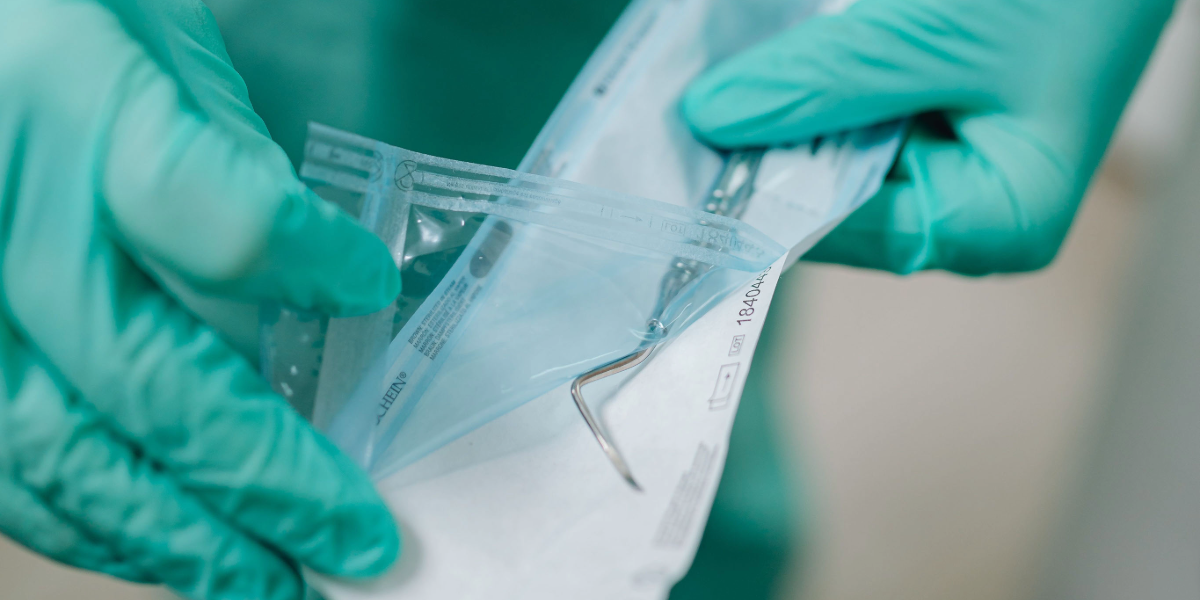
While non-woven materials are quickly replacing traditional plastics and paper in packaging and medical applications, their fibre structures, variable bonding methods, and heat sensitivity are not typically addressed by standard film instruments. Failing to account for these differences in your QC programme increases the risk of missed defects and non-compliant products, which is especially problematic for the highly regulated industries relying on these materials.
This guide covers the material testing equipment you need to evaluate the non-wovens in your packaging. Using RDM Test’s 40+ years of expertise in package testing equipment, we explain the test methods, relevant ASTM and ISO standards, and how to match instruments to your material types.
Key Takeaways: Physical Testing Equipment for Non-Woven Packaging
- Non-woven materials require specific test parameters because their fibre structures behave differently from solid films and papers.
- Heat seal testing, tensile testing, tear resistance, burst strength, and CoF measurement form the core non-woven testing programme.
- ASTM and ISO standards such as ASTM F88, ISO 9073, and ISO 11607 define mandatory test methods for packaging and medical applications.
- RDM Test Equipment offers instruments purpose-built for non-woven packaging quality control. Calibration of these machines, alongside sample preparation and operator training, directly affect the accuracy and repeatability of your test results.
What Are Non-Woven Materials and Why Do They Need Specific Testing?
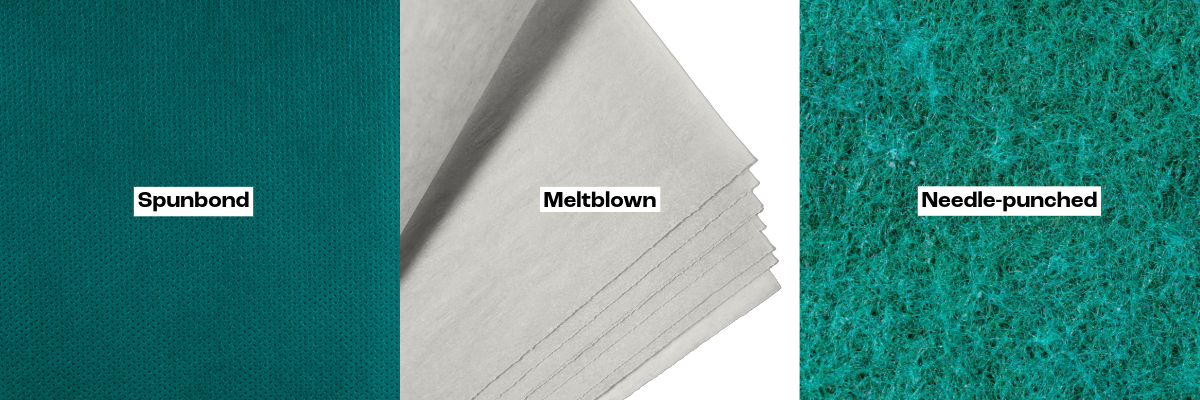
Non-wovens are engineered fabrics made from fibres bonded by thermal, chemical, or mechanical processes rather than weaving or knitting. Common types include spunbond, meltblown, and needle-punched structures, used in sterile medical packaging and food-contact pouches.
Their open fibre architecture creates properties that differ significantly from extruded plastic films. Porosity, fibre orientation, and bonding uniformity all influence tensile strength, elongation, and seal behaviour. A test method calibrated for solid polyethylene film, for example, may produce misleading results on a spunbond polypropylene non-woven.
Testing these materials accurately requires instruments that can handle variable thickness, lower tensile loads, and fibre pull-out failure modes. Your equipment must also comply with non-woven-specific standards, such as ASTM D1117 and the ISO 9073 series.
Which Physical Tests Are Critical for Non-Woven Quality Control?
Heat Seal Strength Testing for Non-Woven Packaging
Non-wovens sealed to plastic films or other non-wovens require precise heat seal parameter control. Temperature, pressure, and dwell time interact differently with porous substrates compared to solid films. Too much heat can melt fibres through the material, while too little creates weak bonds that fail under stress.
Seal strength testing per ASTM F88 measures the peel force needed to separate a sealed joint. For medical packaging, this test is mandatory under ISO 11607.
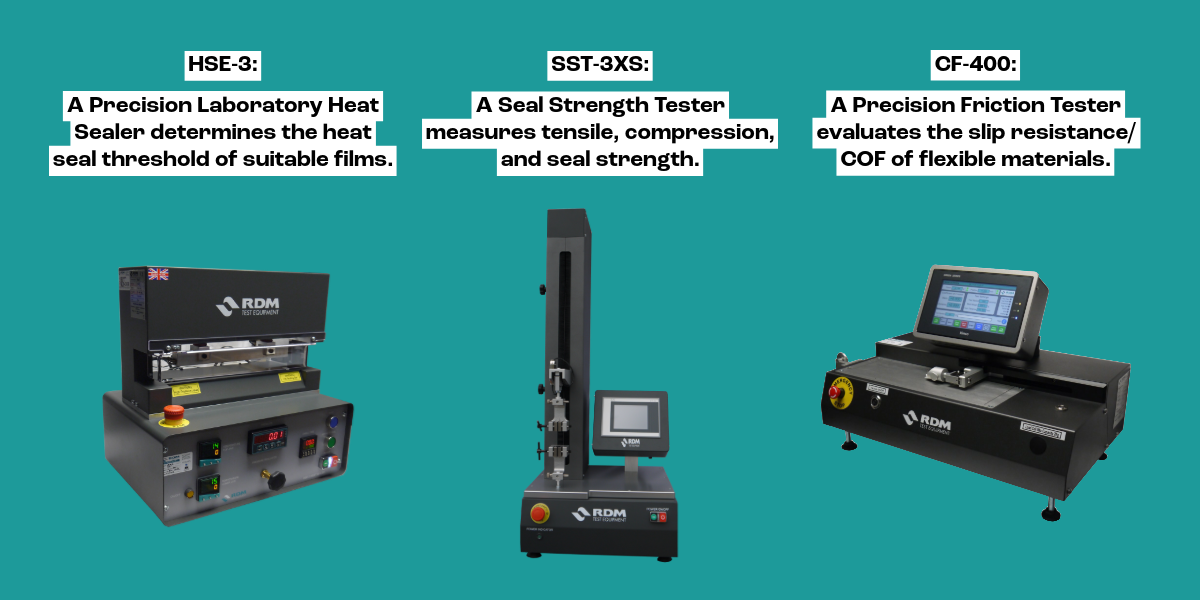
The HSE-3 Laboratory Heat Sealer from RDM Test Equipment enables you to prepare controlled test specimens at defined sealing parameters. This data lets you optimise seal windows for non-woven structures.
Tensile Strength and Elongation Testing
Tensile testing reveals how non-woven materials respond to pulling forces. You measure ultimate tensile strength, yield point, and elongation at break. These values help you evaluate whether a material will survive forming and filling, as well as transportation stresses.
Non-wovens often exhibit different tensile behaviour in the machine direction (MD) versus the cross direction (CD). Testing both directions is standard practice, and most specifications require it. RDM Test’s SST-3XS Seal Strength Tester handles tensile, seal strength, and compression tests on a single platform to standards including ASTM F88 and ISO EN 868-5.
CoF Testing for Non-Woven Surfaces
CoF testing determines how easily non-woven surfaces slide against each other or against equipment parts. Static CoF measures the force needed to initiate sliding, while kinetic CoF measures the force during motion. Both values directly affect packaging line performance.
Non-wovens with inconsistent CoF values can cause feeding problems, misalignment, and stacking failures on automated lines. The CF-400 Precision Friction Tester from RDM Test Equipment measures both static and kinetic CoF per ASTM D1894 and ISO 8295, covering the full range of non-woven surface types.
Tear Resistance Testing
Tear resistance measures the force required to propagate a tear through a material that already has an initial cut. For non-wovens, this is especially relevant because fibre bonding patterns create unique directional tear strength differences.
The Elmendorf method (ASTM D1424 / ISO 1974) is the standard test method approach. RDM Test Equipment sells the Elmendorf Tear Tester, which covers non-woven, paper, and film applications in a single instrument. The pendulum-based design delivers consistent energy application across samples with an initial, precise notch.
Burst Strength Testing
Burst testing applies multi-directional pressure to a clamped specimen until it ruptures. This method highlights weaknesses that uniaxial tensile testing may miss, including bonding defects and fibre orientation issues.
For non-wovens, burst testing follows EDANA NWSP 30.1, EDANA NWSP 30.2, and ISO 13938-1. The 13-56 Burst Tester, also sold by RDM Test Equipment, supports these standards and accommodates materials ranging from lightweight spunbond to heavy needle-punched substrates.
What Standards Govern Non-Woven Testing in Packaging and Medical Applications?
ASTM Standards for Non-Woven Materials
ASTM D1117 is the primary guide for evaluating non-woven fabrics. It references test methods for tensile strength, tear resistance, burst strength, and other physical properties. Additional ASTM standards apply depending on the end-use application.
For packaging seals, ASTM F88 defines seal strength testing and ASTM F2029 covers laboratory heat sealer requirements. ASTM D1894 governs CoF measurement. If you are testing non-wovens for packaging, your instruments must comply with these specific method requirements.
ISO Standards for Medical and Sterile Packaging
ISO 11607-1 and ISO 11607-2 set requirements for packaging used to maintain sterility of terminally sterilised medical devices. EN 868-9 specifically addresses polyolefin non-woven materials for sterile medical packaging.
These standards require validated seal strength testing, package integrity verification, and documented process qualification. Your test equipment needs to support IQ/OQ/PQ validation protocols.
EDANA and Industry-Specific Test Methods
EDANA publishes the Nonwoven Standard Procedures (NWSP) series, which covers tests specifically developed for non-woven fabrics. NWSP 30.1 and 30.2 address burst strength, while other NWSP methods cover absorbency, filtration efficiency, and liquid barrier properties.
If your non-woven-protected products serve hygiene, filtration, or industrial wiping markets, EDANA methods often supplement or replace general ASTM and ISO procedures, so be sure to identify the relevant test methods before selecting equipment.
How to Select Testing Equipment for Non-Woven Materials
Matching Instruments to Your Non-Woven Type
Spunbond materials tend to be stronger and more uniform than needle-punched or wet-laid non-wovens. Meltblown layers, common in filtration and medical barriers, are delicate and require careful sample handling. Each type demands different grip configurations and load cell capacities, alongside test speeds.
Start by listing the specific physical properties your customers or regulations require you to measure. Then match each property to a test method and instrument. RDM Test Equipment’s non-woven testing range covers heat sealing, CoF, tensile, tear, burst, and impact testing, all from instruments designed for these substrates.
Evaluating Load Cell Range and Grip Configurations
Non-wovens typically require lower force ranges than solid plastics. A tensile tester with a 1000 N load cell may lack resolution for lightweight spunbond samples, while heavy composite non-wovens may exceed the capacity of instruments designed for thin films.
Grip design also matters. Pneumatic grips with appropriate jaw faces prevent fibre slippage during testing. Face grips with rubber-coated surfaces work well for most non-wovens, while specialised clamps may be needed for very thick or heavily textured materials.
Sample Preparation Considerations for Non-Wovens
Consistent sample dimensions are critical for repeatable results. Non-wovens can fray at cut edges, which affects tensile and tear measurements. Precision cutters that deliver clean, parallel edges reduce variability. RDM Test Equipment offers sample cutters designed to work with fibrous materials.
Conditioning is equally important. Non-wovens absorb moisture differently depending on fibre type and bonding method. Standard conditioning at 23°C and 50% relative humidity per ASTM D685 should precede all physical tests to minimise environmental variability.
How to Test Non-Wovens for Medical Packaging Compliance
Peel Testing Per ISO 11607 and ASTM F88
The peel test measures the force required to separate a sealed joint at a controlled rate. For non-woven medical pouches, the failure mode is as important as the force value.
A clean peel indicates good seal control. Fibre tear or delamination suggests the seal is too strong or the material too weak.
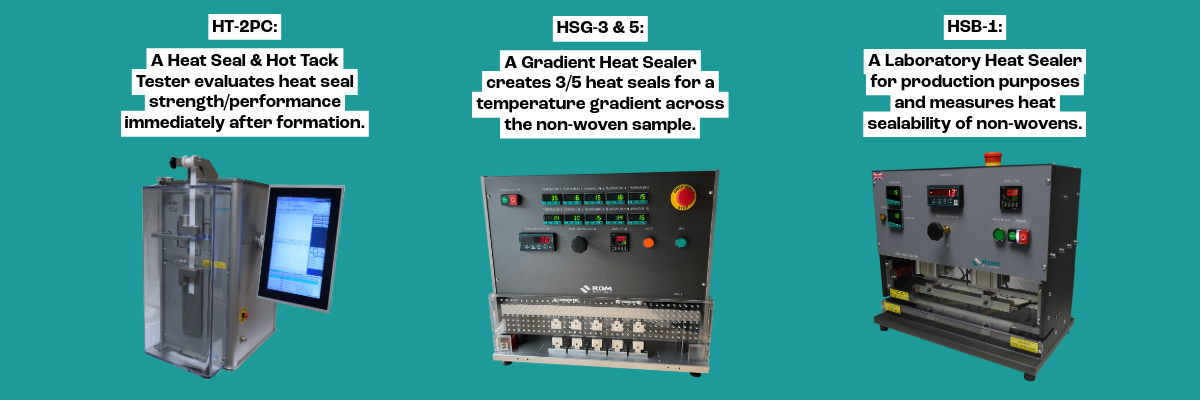
RDM Test Equipment’s heat seal and hot tack testing instruments help you prepare specimens at controlled parameters. You then test them on a calibrated tensile tester to obtain both force and failure mode data.
Process Validation and Documentation Requirements
ISO 11607-2 requires that sealing processes are validated and that equipment is qualified. IQ (Installation Qualification) confirms the instrument is installed correctly. OQ (Operational Qualification) verifies it operates according to specifications. PQ (Performance Qualification) demonstrates consistent results under production conditions.
Your testing instruments must support traceability. Data logging, user access controls, and audit trails help satisfy regulatory auditors. RDM Test Equipment offers calibration and service traceable to UKAS standards, supporting your documentation requirements.
How to Build a Non-Woven Testing Programme Step by Step
Step 1: Identify Your Material Types and End-Use Requirements
List every non-woven material in your product portfolio, along with the packaging formats they serve. Note whether each application falls under medical, food, industrial, or consumer goods requirements. This mapping determines which standards and test methods apply.
Step 2: Map Test Methods to Required Properties
For each material and application, identify the physical properties you must measure. Cross-reference these with the applicable ASTM, ISO, or EDANA test methods. Group tests that can share a single instrument to maximise your equipment investment.
Step 3: Specify Equipment Based on Method Requirements
Select instruments that meet the exact requirements of your identified test methods. Verify load cell ranges, test speeds, grip types, and data output capabilities. Confirm compliance with the specific standard editions your customers require.
Step 4: Establish Sample Preparation and Conditioning Procedures
Document your sample cutting, conditioning, and handling procedures. Consistent preparation is the foundation of reliable testing. Train every operator on these procedures and verify compliance regularly.
Step 5: Validate, Calibrate, and Train
Install and qualify equipment per your quality system requirements. Calibrate instruments to traceable standards and schedule regular recalibration intervals. Train operators on both the instruments and the test methods. RDM Test Equipment offers installation, commissioning, and training to help you establish testing capability with confidence.
In Conclusion: Selecting Physical Testing Equipment for Non-Wovens
Building an effective non-woven testing programme starts with understanding your materials, identifying the standards your customers and regulators require, and selecting instruments that match those method specifications. Heat seal testing, tensile measurement, tear resistance, burst strength, and CoF testing form the core of most non-woven quality control programmes.
Accurate data from calibrated, standards-compliant instruments protects your products, your customers, and your reputation. RDM Test Equipment delivers the precision, reliability, and technical support that packaging and medical material teams need to control non-woven quality with confidence.
Contact RDM Test Equipment to discuss your specific testing requirements and discover how to strengthen your quality control programme.
FAQs about Physical Testing Equipment for Non-Woven Packaging
What is the most important physical test for non-woven packaging?
Seal strength testing per ASTM F88 is typically the most critical test for non-woven packaging. Weak or inconsistent seals lead to product contamination and regulatory failures. RDM Test Equipment’s HSE-3 Laboratory Heat Sealer helps you prepare controlled test specimens for accurate seal evaluation.
Which ASTM standard covers non-woven fabric evaluation?
ASTM D1117 is the primary guide for evaluating non-woven fabrics. It references test methods for tensile, tear, burst, and other physical properties. Additional standards like ASTM F88 and ASTM D1894 apply when non-wovens are used in packaging seals and require CoF measurement.
Can one instrument test both non-wovens and plastic films?
Many of RDM Test’s instruments can handle both material types with appropriate grip changes and test parameter adjustments. Just note that parameters like jaw gap, test speed, and grip pressure all need adjustment for fibrous substrates. The SST-3XS, for instance, supports tensile, seal strength, and compression testing across non-wovens, films, and laminates on a single platform.
How does non-woven burst testing differ from tensile testing?
Tensile testing applies force in one direction. Burst testing applies multi-directional pressure, revealing bonding defects and orientation weaknesses that tensile tests may miss. Non-wovens can exhibit significant differences in strength and elongation between the MD and CD. Both tests are recommended for non-wovens to get a complete picture of material performance..
Why does CoF matter for non-woven packaging?
CoF determines how non-woven surfaces interact during production, stacking, and transport. Inconsistent values cause feeding problems and stacking failures on automated packaging lines. RDM Test Equipment’s CF-400 measures both static and kinetic CoF per ASTM D1894 and ISO 8295.
What testing equipment do I need for medical non-woven packaging?
You need a laboratory heat sealer (such as the RDM Test Equipment HSE-3), a tensile/seal strength tester, and a leak detection instrument. ISO 11607 requires validated seal integrity and seal strength testing for sterile barrier packaging.
How often should non-woven testing equipment be calibrated?
Most quality systems require annual calibration, though some medical applications demand six-monthly verification. RDM Test Equipment offers calibration traceable to UKAS standards, helping you maintain measurement accuracy and audit readiness.
Keep Reading